


Sleep isn't just a nice-to-have for athletes—it's your secret weapon. When basketball players at Stanford…
The Importance of Sleep for Professional Swimmers: Recovery, Performance and the Science Behind Better Training
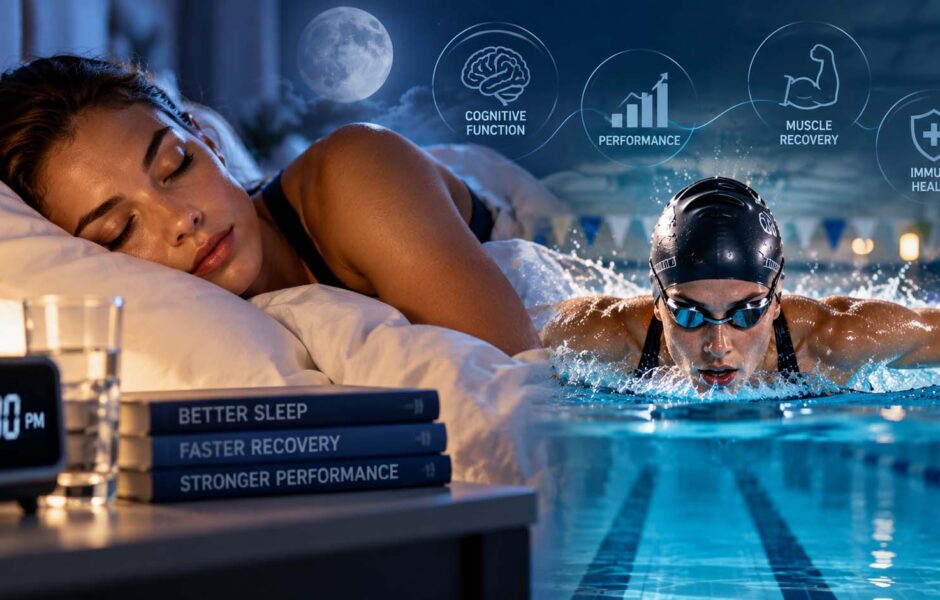
Sleep should be given the same attention as training volume, stroke biomechanics, and nutrition in elite swimming programs. Sleep plays a role in muscle recovery, cognitive function, motor learning and emotional regulation. According to a review carried out in 2026 by Fursov and his colleagues, sleep disturbances affect about 58 to 70 per cent of top athletes, the causes include training demands, psychological stress, travel and irregular schedules. These results are pertinent to swimming programmers that are based on early-morning practices, double sessions and a high frequency of competitions.
The importance of sleep for achieving top-level swimming performance
The United States Olympic & Paralympic Committee (USOPC) states that insufficient sleep can influence immune function, metabolism, cellular repair, learning, memory, concentration, decision-making and reaction time. The USOPC also finds links between the quality of sleep and aerobic endurance, speed, the production of maximum force and the execution of motor skills.
Muscle recovery and training adaptation
Professional swimmers subject their muscles to heavy workloads both in the pool and in the weight room. Sleep plays a role in tissue repair and adaptation. The review from 2026 points out that a decrease in slow-wave sleep could be a factor in impaired muscle repair and in the replenishment of glycogen. Inadequate sleep taken consistently might affect recovery following intense sessions.
Motor learning and stroke technique
To swim one must coordinate breathing, body rotation, the movement of the arms, kicking and propulsion. Since sleep plays a role in learning and the consolidation of memory it is relevant to athletes when they are practicing and retaining technical changes.
Reaction time and cognitive performance
The starting procedure, the turn and the pace all rely on quick reactions and accurate performance. Although it has been found that the quality of sleep is linked to reaction time, decision-making and motor skills, the sources given do not show any specific improvement in swimming race times.
What the Most Recent Research Shows Regarding Sleep Deprivation
Fursov and his colleagues looked at the research carried out between 2013 and 2024 concerning sleep disturbances in top-level athletes. In their 2026 review they report the following results. These figures are not specific to swimming and have not been independently checked against the original studies.
- Sleep disturbances among elite athletes: 58–70%
- Injury-risk association with chronic sleep deprivation: 1.7-fold
- Sprint-performance reduction after three nights of ≤5 hours sleep: 3.1%
- Increase in perceived exertion in the same restriction research: 17%
The sprint results mentioned in the review refer to athletes involved in team sports, not to swimming race times. Sleep restriction could also make already familiar workloads seem more demanding. The injury figure represents an association and not proof that sleep deprivation on its own causes injury.
The review also looks at the connections between sleep disturbances, anxiety, psychological stress and emotional regulation. Coaches should consider ongoing sleep problems together with training load, nutrition and psychological well-being.
How Much Sleep Do Professional Swimmers Require?
The USOPC stresses that the amount of sleep needed differs according to age and individual circumstances, stating that most adults should have 7 to 9 hours and that most adolescents should have 8 to 10 hours. When it comes to elite athletes, in addition to considering the duration of sleep, attention should also be paid to sleep quality and individual training requirements.
Adhering to a regular sleep and wake timetable helps to maintain the circadian rhythm. Starting sessions early and holding them late, as well as the short gap between the two double sessions, can reduce the amount of sleep available. A single bad night does not necessarily lead to poor performance in competition; the USOPC emphasizes the importance of having had good nights’ sleep in the days before and advises against causing unnecessary anxiety over an occasional disruption.
Early-Morning Training: A Difficulty for Competitive Swimmers
The USOPC considers both early and late training times to be typical obstacles to achieving healthy sleep. In the case of swimmers who train twice a day, the time required for commuting, having their meals and settling down after the evening practice may result in a narrow time period before the following early session.
Coaches are able to look at the time that elapses between the evening and morning sessions, co-ordinate the scheduling during intensive training periods and take into account opportunities for sleep together with time in the pool. The adjustments made should correspond with the particular athlete’s recovery requirements.
Napping as a Method of Recovery
The USOPC suggests that it is worthwhile to take naps at the right time when one does not get enough sleep at night. A short nap of 20 to 30 minutes can enhance alertness and reaction time while causing less grogginess. However, a nap of 60 to 90 minutes may enable more profound recovery but means that it will take longer to become fully alert again. The USOPC considers the period around 1 to 4 p.m. to be a useful time for napping and recommends against napping too late.
Napping may be useful as a way of aiding recovery between double sessions or when travelling, but it should not normally be used as a substitute for sufficient night-time sleep. Those athletes who have ongoing insomnia should obtain personal professional advice.
Anxiety associated with competition, problems with travel, and disturbances of sleep
Performance pressure, anxiety before a competition, cognitive hyperarousal and unfamiliar environments all have the potential to disrupt sleep. The review from 2026 looks at mindfulness-based stress reduction and cognitive behavioral therapy for insomnia (CBT-I); CBT-I is a clinical treatment which must be carried out by properly trained professionals.
The USOPC recommends that, when travelling across time zones, people should slowly adjust their sleep times by approximately 30 to 60 minutes each day towards the time zone of the destination before leaving. While travelling, it may be helpful to stay well hydrated and to use practical sleep aids; once you have arrived, exposure to sunlight at the right time, carrying out structured training and taking strategic naps may all assist with getting back in sync.
Evidence-Based Sleep Strategies for Swim Coaches
- Encourage consistent sleep and wake times with sufficient opportunity for rest.
- Support a wind-down routine and stress-reduction techniques before bed.
- Consider the USOPC recommendation to avoid caffeine within eight hours of bedtime.
- Review sleep opportunities when planning early practices and double sessions.
- Discuss sleep quality alongside fatigue, perceived exertion and training load.
- Use sleep diaries or other monitoring as supporting information, not a clinical diagnosis.
- Refer persistent insomnia, excessive daytime sleepiness or significant disturbances to qualified healthcare professionals.
Better Recovery and Better Technique: Where SwimMirror Fits
Sleep plays a role in recovery and in the processes associated with learning. Through technical practice swimmers are given the chance to develop efficient movement patterns. With SwimMirror athletes are able to obtain immediate visual feedback so that they can see their stroke technique while they are practicing.
SwimMirror HD offers high-definition clarity without the aluminum grain of the original model, is 25% lighter than the original, and uses corrosion-resistant construction. It requires minimal maintenance: rinse and air dry. SwimMirror has received an endorsement from three-time Olympic gold medalist Rowdy Gaines. [3]
Prioritize recovery. Refine technique. Make every training session count.
See SwimMirror HD at https://swimmirror.com/
Key Takeaways for Professional Swim Coaches
- Sleep plays a role in cellular repair, in metabolism, in learning and in other processes which are relevant to athletic recovery.
- The 2026 review reports sleep disturbances among 58–70% of elite athletes; this is not a swimmer-specific estimate.
- Typical USOPC ranges are 7–9 hours for adults and 8–10 hours for adolescents, with individual variation.
- Early and late training, competition stress and travel can reduce sleep opportunities.
- Well-timed naps can complement, but not routinely replace, nighttime sleep.
- SwimMirror provides real-time visual feedback as a separate component of technical training.
Frequently Asked Questions
How much sleep should professional swimmers get?
The USOPC identifies 7–9 hours for most adults and 8–10 hours for most adolescents. Individual needs, training demands and sleep quality also matter.
Does sleep deprivation affect swimming performance?
Inadequate sleep can affect recovery, reaction time, cognition and motor execution. The supplied sources do not establish a specific change in swimming race times.
Can poor sleep affect stroke technique?
Sleep supports motor learning and attention. Persistent restriction may make it harder to learn or consistently execute technical changes; the supplied sources do not quantify stroke-efficiency effects.
Should swimmers nap between training sessions?
Naps can help some athletes. The USOPC suggests 20–30 minutes for alertness and describes longer 60–90-minute naps as an option when more recovery time is available.
How can coaches help athletes improve sleep?
Review training schedules, encourage consistent routines, discuss sleep quality and refer persistent problems to qualified professionals.
What if a swimmer sleeps poorly before competition?
One poor night does not automatically mean poor performance. The USOPC emphasizes consistent habits before competition and avoiding unnecessary anxiety.
Can sleep improve recovery between sessions?
Adequate sleep supports repair and metabolic processes involved in recovery. It complements appropriate nutrition, hydration and training-load management.
How does SwimMirror complement recovery and training?
SwimMirror offers immediate visual feedback during stroke practice. It does not replace sleep or other recovery practices.
Conclusion
When creating training programmers, assessing fatigue and preparing swimmers for competition, sleep should be considered due to its role in recovery, in learning and for psychological well-being adds to that provided by structured conditioning and technical practice. SwimMirror HD offers coaches with another means of incorporating visual feedback into their training.
Discover SwimMirror HD at https://swimmirror.com/