

In the competitive world of swimming, mastering the art of taper swimming has become a…
Smart Swimming Coach: How Data Analytics Improves Pool Performance
January 20, 2026Uncategorized
Swimming performance optimization has entered a new era with elite swimmers experiencing 2-3 times faster improvement in specific skills when using modern technology compared to traditional instruction alone. This technological revolution isn’t just changing how athletes train—it’s fundamentally transforming the entire coaching process.
At the forefront of this transformation, AI-powered systems can now monitor 17 different points of an athlete’s body, providing coaches with precise data to optimize training programs. Furthermore, real-time swim feedback through video analytics has become a valuable tool for coaches seeking to fine-tune their strategies with greater accuracy. Specifically, artificial intelligence algorithms can now identify different stages of swimming strokes with good probability, while simultaneously generating tailored lesson plans based on individual swimmer needs.
This article explores how data analytics is revolutionizing swimming performance, examining the technologies behind competitive swim training, and demonstrating how biomechanical swim improvement through technology provides objective, measurable feedback without requiring enormous investments in computing hardware.
The rise of data analytics in swimming
The evolution of swim training tools began with a revolutionary moment in 1997 when the Strokz Digital Swim Stroke Analysis Watch—the first automatic swim tracking device—hit the market. This groundbreaking technology measured fundamental metrics like stroke count and stroke rate that competitive swimmers rely on for performance assessment.
From stopwatch to smart pool: a quick evolution
Initially, coaches relied solely on stopwatches and their trained eyes to evaluate swimmers. The landscape changed dramatically when Doc Counsilman pioneered slow-motion underwater film analysis in the 1970s. Subsequently, this technology became more accessible, allowing virtually any coach to analyze swimmers’ technique using relatively inexpensive equipment.
By 2009, the SwimSense became one of the first devices to utilize machine learning to automatically detect strokes and distinguish between swimming and rest periods without manual input. Additionally, the market expanded rapidly with Garmin joining the competition in 2012-2013, introducing swim tracking capabilities in their products.
Why traditional coaching methods fall short today
Traditional coaching approaches present several limitations in modern competitive environments. Primarily, video analysis, though valuable, remains subjective. Moreover, the “swim X number of laps” training mindset—though understandable for maximizing pool time—practically ensures minimal improvement and creates slower swimmers.
Perhaps most significantly, traditional feedback methods provide delayed information, as swimmers typically access performance metrics only during rest periods between work bouts. This timing gap substantially impedes technique adjustments and learning efficiency.
How data analytics bridges the performance gap
Data analytics addresses these limitations by providing objective measurements of the two crucial forces determining swim speed: drag and propulsion. According to research, real-time feedback significantly assists with pace control in swimming and accelerates the learning process, enabling swimmers to adapt their technique much more rapidly than traditional methods allow.
Modern tools can track 17-25 different measurements for each stroke, generating comprehensive data that objectively quantifies performance. Notably, this technology has democratized access to elite-level analytics, as amateur swimmers now have access to data once exclusive to top athletes.
The feedback loop created through data analytics—tracking performance, pairing it with coaching observations, designing training based on trends, then assessing and adjusting—creates compound improvements through consistent small corrections. This process transforms swimming training from subjective art to data-driven science.
Key technologies powering smart swim coaching
Modern swimming performance optimization now relies heavily on a range of sophisticated technologies that provide accurate, instant feedback to both coaches and athletes.
Wearables and motion sensors for real-time swim feedback
Inertial Measurement Units (IMUs) have become essential tools for tracking swimmer movements. These devices combine accelerometers, gyroscopes, and magnetometers into a single unit, providing comprehensive kinematic data including acceleration, angular velocity, and orientation. Some devices can be worn comfortably under a swimmer’s cap and generate over 30 different metrics by tracking head movement. Consequently, these wearables can detect stroke type with more than 87% accuracy and count strokes with over 94% precision.
Swim stroke analysis using computer vision
Computer vision technology offers an alternative approach that doesn’t require swimmers to wear devices. This technology uses strategically positioned cameras to record swimmers’ movements both above and below water. Through pose estimation algorithms, the system can automatically detect key body landmarks and calculate critical angles, such as maintaining an elbow angle between 80-100 degrees during the pull phase for optimal freestyle performance. First developed for elite athletes, these systems can now identify stroke inefficiencies with 96% accuracy in analyzed frames.
AI-driven swimming performance tracking tools
AI algorithms have transformed raw swimming data into actionable insights. Platforms like Phlex pair with Polar sensors to deliver advanced performance metrics while monitoring heart rate in real-time. Similarly, Smart Goggles powered by Ciye’s “smart coach” module display lap times and split times with a quick leftward glance, capturing information with over 99% accuracy. In essence, these tools identify technique flaws instantly, allowing for immediate adjustments.
The role of swimmirror and underwater video systems
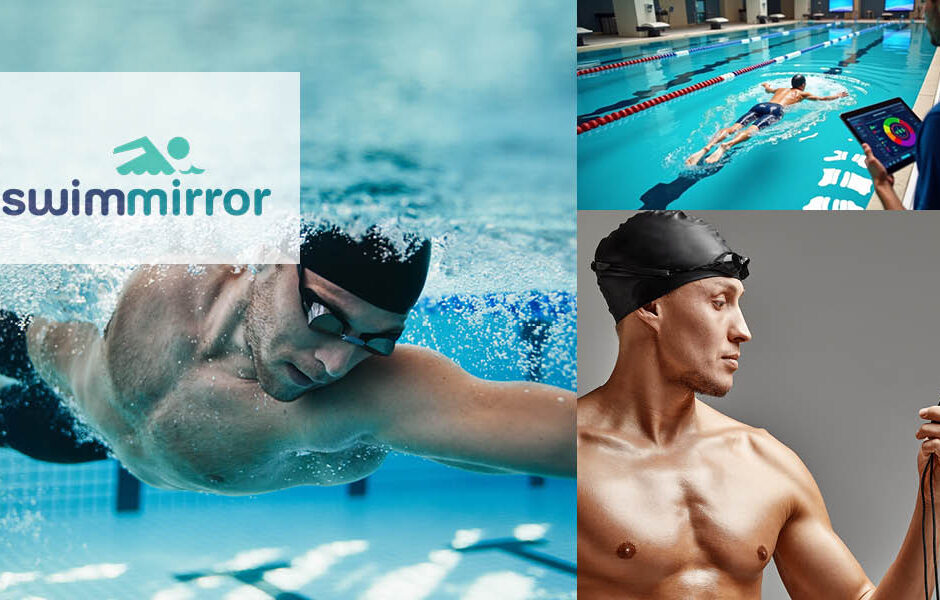
SwimMirror HD represents a straightforward and effective tool for technique improvement. This polished stainless steel mirror lies at the pool bottom, enabling swimmers to observe their strokes in real-time. Paired with underwater camera systems—which offer wireless streaming to iPads with adjustable delays for immediate review—coaches can provide instant visual feedback. These systems eliminate the tedious process of offline scoring from high-speed camera images.
How data improves training and technique
Beyond just collecting data, advanced analytics helps swimmers perfect their technique and reach peak performance levels.
Identifying biomechanical swim improvement areas
Biomechanical analysis through sensors reveals critical technique factors that often remain invisible to the naked eye. Newton’s laws of motion provide the scientific foundation for understanding swimming biomechanics, helping coaches identify inefficiencies in stroke technique. Digital twins—precise replications of swimmers’ movements generated from acceleration data—expose strengths and weaknesses that directly impact performance. For instance, by analyzing hand force data, coaches can identify whether swimmers exert too much force downward rather than backward toward their feet, a common inefficiency in freestyle swimming.
Customizing training plans with performance data
Data-driven personalization helps athletes target specific improvement areas precisely. Rather than using generic “swim X laps” approaches, coaches can develop targeted goals like “increase Distance Per Stroke by 0.2 meters in butterfly within three weeks”. These specific objectives lead to enhanced stroke efficiency and ultimately faster race times. Daily performance monitoring also helps determine if athletes remain on track toward their goals.
Using swimming performance points to set goals
Objective measurements transform vague aspirations into achievable targets. Instead of broad goals like “improve my 100m time,” swimmers now establish specific benchmarks such as “reduce 200 Fly time by 2 seconds within three months”. This specificity, coupled with consistent tracking boosts confidence and motivation as swimmers witness tangible progress.
Preventing injuries through early detection
Data analysis serves as an early warning system for potential injuries. Biomechanical analysis identifies stroke imbalances before they cause damage, particularly important since the shoulder represents the most common injury site among Para swimmers. Research indicates injury prevention programs should be individualized to address specific swimming biomechanics and athlete-specific impairments. Some researchers are even adapting Inertial Measurement Units to work underwater to measure spinal rotation and other subtle movements that might contribute to overuse injuries.
Tracking progress with swimming pool optimizer tools
Performance tracking technology provides comprehensive documentation of improvement over time. Modern tools gather metrics including reaction time, distance per stroke, stroke rate, and fatigue levels. This data helps fine-tune technique, identify imbalances, and prevent overtraining—essential factors in sustained performance improvement. Advanced platforms also track overall well-being, including sleep quality and muscle fatigue, allowing coaches to tailor workouts to each athlete’s physical and emotional state.
Real-world applications and success stories
Data-driven approaches have moved from theory to practice in competitive swimming, with remarkable results at the highest levels of the sport.
Competitive swim training with AI: case examples
Olympic swimmer Kate Douglass demonstrates how analytical approaches produce tangible improvements. At the University of Virginia, Douglass worked with Dr. Ono to apply data from her stroke patterns and water wavelets to improve technique. Using accelerometers with internal gyroscopes and directional force meters, they created her digital twin for analysis. Through this method, Douglass improved her technique, resulting in a 0.11 second savings per streamline glide—enough to break a twelve-year-old American record by 0.29 seconds. Likewise, Paralympic swimmer Mallory Weggemann used Smart Goggles to record training data and send it to her remote coach during the 2020 Paralympics, ultimately winning two gold medals, one silver medal, and breaking two Paralympic records.
How national teams use data to gain an edge
National swimming organizations have embraced data analytics as a competitive advantage. USA Swimming modernized its data capabilities to enhance athlete development nationwide, making self-serve analytics accessible to nearly 400,000 members. Their National Practice Data Project gives participating clubs individualized interactive dashboards to compare athlete performances against collective national data. Meanwhile, Swimming Australia implemented an ML-powered system that processes pool footage from training sessions to extract meaningful insights. This technology delivers 90% faster access to training data and 91% faster footage review, enabling coaches to provide immediate feedback—converting analysis times from hours to seconds.
Conclusion
The integration of data analytics into swimming coaching represents a significant shift from traditional training methods. Smart swimming technology now offers objective measurements across dozens of metrics, enabling coaches to identify technique flaws with remarkable precision. Additionally, these tools create immediate feedback loops that accelerate skill acquisition far beyond what was previously possible.
Athletes at all levels benefit from this technological advancement. Beginners can receive specific guidance on stroke mechanics while elite competitors gain marginal improvements that translate into record-breaking performances. Meanwhile, coaches find themselves freed from manual tracking tasks, allowing them to focus on their true expertise – building relationships and providing personalized guidance.
Perhaps most importantly, data-driven coaching has democratized access to elite-level analytics. Amateur swimmers now utilize tools once reserved for Olympic training centers, while national swimming organizations implement comprehensive systems that benefit hundreds of thousands of members. The results speak for themselves through case studies like Kate Douglass, who shaved critical fractions of seconds off her times through precise technical adjustments.
Therefore, smart swimming coaching no longer exists as merely a competitive advantage but has become an essential component of modern training. The combination of wearable sensors, computer vision, AI analysis, and underwater feedback systems creates a comprehensive framework for continuous improvement. Swimmers who embrace these technologies will undoubtedly find themselves ahead of the competition, swimming faster and more efficiently than ever before.
FAQs
Q1. How does data analytics improve swimming performance?
Data analytics provides objective measurements of crucial factors like drag and propulsion, enabling real-time feedback for swimmers. This allows for immediate technique adjustments, accelerates the learning process, and helps create personalized training plans based on individual performance data.
Q2. What are some key technologies used in smart swim coaching?
Smart swim coaching utilizes various technologies including wearable devices with motion sensors, computer vision for stroke analysis, AI-driven performance tracking tools, and underwater video systems. These technologies provide comprehensive data on swimmer movements, technique, and performance metrics.
Q3. Can data analytics help prevent swimming injuries?
Yes, data analytics can help prevent injuries by identifying stroke imbalances and biomechanical issues before they cause damage. It allows for early detection of potential problems and helps in creating individualized injury prevention programs based on specific swimming biomechanics.
Q4. How do national swimming teams use data analytics?
National swimming organizations use data analytics to enhance athlete development. For example, USA Swimming has implemented self-serve analytics for its members, while Swimming Australia uses ML-powered systems to process training footage. These tools provide faster access to training data and enable immediate feedback for performance improvement.
Q5. What benefits do coaches report from using swim coaching technology?
Coaches report that swim coaching technology enhances their ability to connect with swimmers by freeing them from manual tracking tasks. It allows for real-time feedback during training sessions and provides access to elite-level insights for swimmers at all levels, democratizing high-quality coaching techniques.