


Did you know that most children don't develop a natural fear of water until they're…
How Elite Swimmers Master Stroke Mechanics: A Coach’s Guide to Neural Learning
January 27, 2026Swim Training
Elite stroke mechanics coaching goes far beyond physical training alone. According to research, athletes who use visualization techniques can boost their performance by up to 20%, transforming good swimmers into exceptional ones. This mental aspect of training represents a critical yet often overlooked dimension of swimming excellence.
Additionally, 86% of elite swimmers consider mental training vital to their preparation, highlighting how crucial cognitive development is alongside physical training. Swimming stimulates neurogenesis—the creation of new neurons in the brain—which explains why integrating psychological and cognitive elements into training has been shown to improve performance by 6% during proper tapering periods. Specifically, elite swimmer development depends on this neural-cognitive foundation that enhances reaction time, accuracy, and impulse control.
This guide explores how coaches can leverage swimming biomechanics knowledge alongside mental training techniques to develop superior stroke mechanics. From visualization methods to real-time feedback tools like Swimmirror, readers will discover how the integration of neural learning principles can transform their coaching approach and elevate their swimmers’ performance to elite levels.
The Role of Neural Learning in Stroke Mastery
Neural mechanisms fundamentally determine how swimmers master stroke mechanics. Motor skill learning creates measurable changes in the brain through neuroplastic cortical reorganization. This process doesn’t merely improve performance—it physically rewires the brain to optimize movement patterns.
How motor learning shapes elite swim technique
The primary motor cortex (M1) undergoes significant adaptation through swimming training. Research shows that elite swimmers develop superior sensorimotor skills that remain remarkably consistent regardless of environment. This stability explains why top competitors maintain technique excellence even under race pressure.
Furthermore, the cortical inhibition patterns in experienced swimmers differ significantly from novices when immersed in water. These distinct neural adaptations reveal why skilled swimmers appear to move effortlessly through water—their brains process aquatic environments differently.
Studies show swimming performance is determined approximately 75% by skill and only 25% by aerobic conditioning at elite levels. For novice and intermediate swimmers, skill contribution jumps to nearly 90%. This highlights why technique-focused neural training delivers greater performance gains than pure endurance work.
Neuroplasticity and its impact on stroke refinement
Neuroplasticity—the brain’s ability to reorganize itself—creates the foundation for stroke mastery. Each repetition of proper technique strengthens neural pathways, making movements more efficient and automatic. Consequently, what initially requires intense concentration eventually becomes second nature.
When children learn swim strokes, their motor cortex physically reorganizes. This transformation explains why coordinating complex movements like butterfly becomes progressively easier. The brain literally changes its structure to accommodate new skills.
Neural network analysis has proven remarkably accurate in predicting swimming performance, with prediction errors below 0.8% between true and estimated performances. This precision confirms the critical relationship between neural adaptation and swimming excellence.
Why repetition alone isn’t enough for skill retention
While repetition is essential, quality trumps quantity in neural development. Sub-optimal repetitions not only fail to advance neural conditioning but actually degrade it. This explains why mindless laps without technical focus can reinforce poor habits.
Mental rehearsal provides a powerful complement to physical practice. Brain imaging reveals that visualizing swimming activates the same neural circuits as actual performance. This allows swimmers to strengthen technique-specific pathways without physical fatigue.
For optimal skill retention, swimmers should combine:
- Quality-focused repetition that builds proper neural pathways
- Mental visualization to reinforce technique patterns
- Environment variation to enhance neural adaptability
Rather than simply accumulating yardage, elite stroke mechanics coaching must prioritize neural conditioning that creates lasting technical excellence.
Building Stroke Awareness Through Mental Cues
Mental cues serve as powerful tools for stroke mechanics coaching. These verbal and visual prompts create direct neural pathways that translate into improved technique. Unlike mindless repetition, cue-based training establishes precise movement patterns that remain consistent under competitive pressure.
Using cue words to reinforce technique
Performance cues act as a mental checklist for swimmers, allowing them to turn off analytical thinking and simply execute. Studies show athletes using specific cue words improved performance by over 2% and reduced performance variance by 60%. These short, focused prompts help swimmers maintain form throughout races and practice.
Effective cue words include:
- “One goggle out” – minimizes head rotation during breathing
- “Finger tips down” – establishes proper catch position
- “Hulk smash” – encourages powerful finishing strokes
Elite coaches begin instructions with action verbs—feel, see, imagine—creating immediate neural connections between concept and movement. These verbal anchors prevent technique breakdown, especially during fatigue or high-pressure situations.
Visualization techniques for stroke correction
Visualization activates identical neural circuits as physical swimming. Research shows the brain struggles to differentiate between vividly imagined experiences and actual swimming. This neurological phenomenon explains why visualization enhances technique without physical fatigue.
Michael Phelps famously used visualization before races, mentally rehearsing every aspect including potential problems like water-filled goggles. This comprehensive mental preparation created neural pathways that activated automatically during competition.
Linking mental rehearsal to muscle memory
Mental imagery creates lasting motor programs in the brain. When swimmers visualize perfect technique, they establish neural patterns that later guide physical movement. These mental rehearsals make technical adjustments easier when returning to the pool.
Combining visualization with specific cues maximizes neural adaptation. Swimmers should incorporate both techniques daily, spending 5-10 minutes visualizing perfect strokes while focusing on corresponding cue words. This combined approach cements technique changes more effectively than physical practice alone.
Drills That Reinforce Neural Patterns in Stroke Mechanics
Specific swimming drills create powerful neural connections that transform swimming technique. Through targeted repetitions, these exercises build motor pathways that become increasingly automatic over time.
Swimming drills for technique
High elbow catch – The high elbow catch represents one of the most crucial techniques for distance freestyle efficiency. Elite distance swimmers maintain elbows near the surface while the hand pushes backward, creating optimal propulsion through proper arm positioning. Three highly effective drills include:
One Arm Swim – Isolating each arm allows swimmers to focus on precise pulling motions while maintaining the elbow just below the surface. This drill promotes neural patterns for correct arm positioning.
Knuckle Paddles – By gripping the top of paddles without straps, swimmers develop proprioception for maintaining fingertips pointed downward throughout the pull phase.
Sculling drills to improve proprioception
Sculling develops essential water feel through small, controlled hand movements. These drills build kinesthetic awareness – the sense of hand position and pressure in water. For building neural connections, coaches should implement:
Front Scull – With arms extended, swimmers create figure-eight motions focusing on finger and forearm awareness.
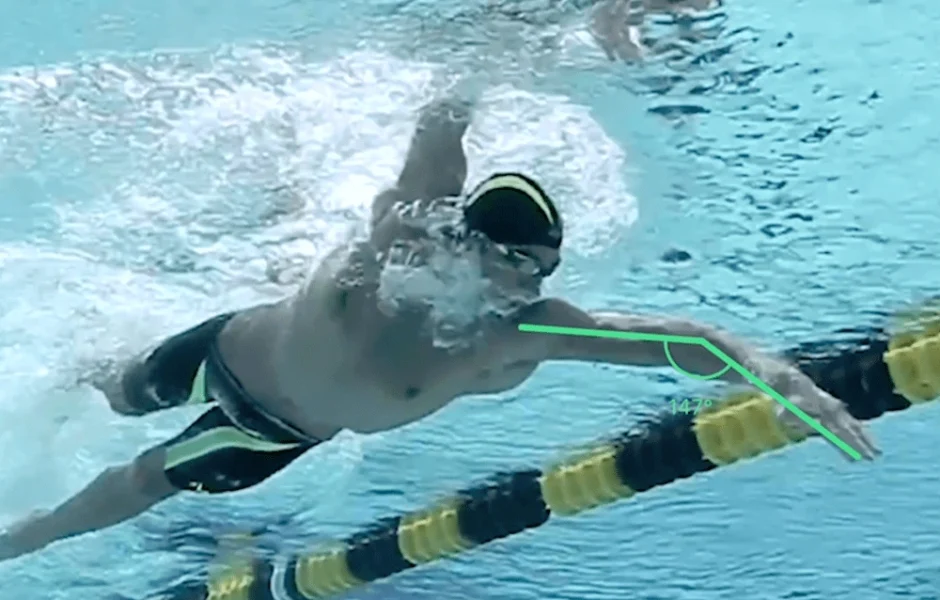
Catch Phase Scull – Swimmers position arms with elbows bent 100-120 degrees, creating a “power diamond” formation between shoulders, elbows and hands.
Tempo-based drills for rhythm and timing
Tempo trainers – small waterproof metronomes placed under swim caps – develop precise stroke rhythm. Research shows these devices help swimmers achieve efficient racing tempo that transfers directly to competition.
A progressive tempo training approach starts with establishing baseline stroke rate, then gradually decreasing time intervals by 0.02 seconds to challenge neural adaptation.
Drill progression for butterfly and breaststroke
Effective butterfly development follows sequenced progressions starting with fundamental movements. Coaches should begin with:
- Aquaman drill (butterfly kick with arms at sides)
- Acceleration drill (focusing on elbow position)
- Full stroke integration
Similarly, breaststroke progressions should move through specific sequences:
- Front to middle scull transitions
- Body dolphin with breaststroke pull
- Separation drill for timing
Integrating Real-Time Feedback for Stroke Correction
Immediate feedback technologies transform stroke mechanics coaching by providing instant correction opportunities. This critical moment—when swimmers can see or feel their technique flaws—creates powerful neural connections that accelerate skill development.
Using Swimmirror for visual feedback for swimmers
SwimMirror delivers crystal-clear underwater reflection, allowing swimmers to observe their technique in real-time. Olympic gold medalist Rowdy Gaines notes, “SwimMirror allows you to see your movements in real-time so you can improve your technique right on the spot”. Indeed, this visual learning track works alongside traditional verbal coaching, opening a second pathway for understanding stroke mechanics.
Stroke coach tools for instant correction
Beyond mirrors, innovative communication devices now enable direct coach-swimmer interaction during practice. The Swim Coach Communicator utilizes Bluetooth technology to transmit instructions directly to swimmers through bone conduction audio, preventing technique flaws before they become habits. Moreover, systems like ESP32 microcontrollers with vibration motors provide haptic feedback when strokes deviate from ideal patterns.
How real-time feedback accelerates neural adaptation
Research confirms that immediate visual feedback helps swimmers hit target times far more accurately than those without such guidance. This instant feedback creates a tight learning loop, allowing correction while muscle memory remains active. Hence, swimmers develop proper technique much faster through self-correction, instantly connecting what they’re thinking with what they’re doing.
Conclusion
Elite swimming technique ultimately depends on the powerful connection between mind and body. Throughout this guide, we have explored how neural learning fundamentally transforms swimming performance beyond pure physical conditioning. Research clearly demonstrates that technique mastery accounts for up to 90% of performance in developing swimmers, therefore making neural training essential rather than optional.
The brain’s remarkable neuroplasticity allows swimmers to reshape their motor pathways through quality-focused practice. However, mindless repetition fails to deliver optimal results. Instead, coaches must combine physical drills with targeted mental techniques such as visualization and specific verbal cues. These methods activate identical neural circuits as actual swimming, essentially creating technique improvements without physical fatigue.
Specialized drills like high elbow catch exercises and sculling fundamentally rewire swimmers’ neural patterns, building automaticity that persists under competitive pressure. Additionally, real-time feedback tools such as SwimMirror provide immediate correction opportunities that accelerate skill development through tight learning loops.
Coaches who understand these neural mechanisms can design training programs that develop superior stroke mechanics more efficiently than traditional approaches. The integration of visualization techniques, proprioception development, and immediate feedback creates a comprehensive system for neural adaptation. Swimmers consequently achieve that seemingly effortless technique that distinguishes champions from competitors.
The future of elite swimming undoubtedly lies at this intersection of neuroscience and biomechanics. Coaches who embrace this neural learning approach will develop athletes who not only swim faster but maintain technical excellence regardless of fatigue or pressure. After all, championship performances emerge not just from physically trained bodies but from neurologically optimized minds.
Want to apply these insights to your training or coaching? Tools like SwimMirror HD are designed to support real-time stroke correction and reinforce neural learning in every session.
Explore how SwimMirror can elevate your stroke mechanics coaching.
FAQs
Q1. What is the most effective way for swimmers to improve their stroke mechanics?
Combining quality-focused repetition, mental visualization, and varied training environments is key to improving stroke mechanics. This approach builds proper neural pathways, reinforces technique patterns, and enhances neural adaptability.
Q2. How does visualization help in mastering swimming techniques?
Visualization activates the same neural circuits as physical swimming, allowing swimmers to strengthen technique-specific pathways without physical fatigue. It helps create lasting motor programs in the brain that guide physical movement during actual swimming.
Q3. What role do mental cues play in stroke refinement?
Mental cues serve as powerful tools for reinforcing proper technique. These short, focused prompts help swimmers maintain form throughout races and practice, acting as a mental checklist that allows them to execute movements more efficiently.
Q4. Why is real-time feedback important in swimming training?
Real-time feedback, such as underwater mirrors or coach communication devices, provides instant correction opportunities. This immediate feedback creates a tight learning loop, allowing swimmers to correct their technique while muscle memory is still active, accelerating skill development.
Q5. How does neural learning contribute to elite swimming performance?
Neural learning is crucial in developing superior stroke mechanics. It involves the brain’s ability to reorganize itself (neuroplasticity), creating efficient neural pathways for complex movements. This process helps swimmers perform with greater efficiency and consistency, especially under competitive pressure.