
How to Improve Your Freestyle Technique Using Visual Feedback
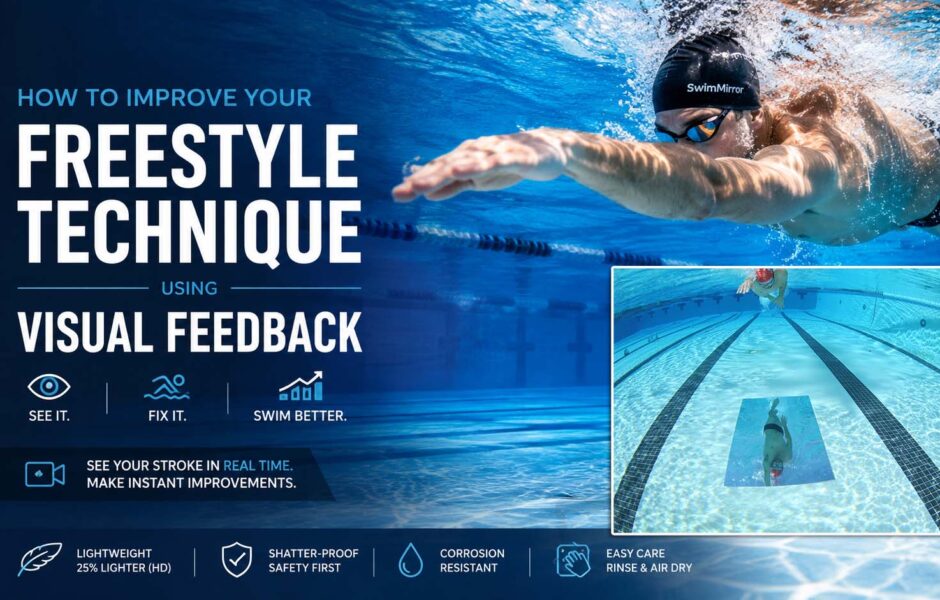
Watch your freestyle stroke in real time and use what you see to improve your technique.
From the viewpoint of someone on the deck, freestyle appears to be simple… simply take turns with your arms, keep your kicking steady, breathe, and carry on moving forward. However, below the surface, efficient freestyle relies on a number of movements working in unison, such as body position, rotation, the pulling motion, the kick, and breathing. When teaching swimmers how to improve their stroke, U.S. Masters Swimming divides freestyle technique into these same key areas.
The problem is that it’s not easy to know precisely what your body is doing when you’re swimming. You might feel as though you’re performing smoothly even though your hips are moving in a way that differs from what was expected. Your hand entry could seem to be in the center even though it is crossing the body’s midline. You could believe that your pull is following the route you had intended, but since you can’t see the movement, it is hard to tell the difference between what you perceive and what is actually happening.
Swimmers need not depend entirely on the way a stroke feels since they can use visual feedback to watch certain aspects of their technique and make the necessary adjustments during practice.
Why Visual Feedback Matters in Freestyle
Normally, the feedback that coaching provides comes from the pool deck, where you swim a length, stop, hear your coach’s advice and then attempt the correction on the following repetition.
Real-time visual feedback also provides a different point of view; using a pool mirror like SwimMirror, swimmers are able to see their movements as they are practicing and thus can associate how a movement feels with how it actually looks when underwater. SwimMirror is in fact designed to give this real-time visual feedback without requiring complicated construction or the use of any extra attachments. What this means for freestyle swimmers is that they turn the pool into a learning environment where they can concentrate on one part of the stroke at a time.
Begin with your body position.
Before you focus on your arms, you should first consider the position of your whole body. The freestyle technique relies on keeping an effective body position while coordinating the rotation from one side to the other; U.S. Masters Swimming regards body position and rotation as basic elements of freestyle and employs drills that focus on controlled rotation as each arm goes through the stroke. When you are swimming over a mirror, notice your general alignment.
Ask yourself:
- Is your body long and well-controlled?
- Is your side to side hip movement going too far?
- Does your body move smoothly as each arm is moved?
- Is the way that you move the same on one side as it is on the other?
What you should do is not to keep staring at the mirror for the whole duration but rather select a particular checkpoint and focus on it during the controlled repetitions. By concentrating on that approach, visual feedback can become a great deal more useful.
Take care with the way your hand enters the water.
Another area involving hand entry is that being able to see your stroke can show something which might be hard to feel. A hand entry which crosses the body’s midline is one of the technique problems that U.S. Masters Swimming talks about, and the coaching advice they give makes use of visual reference points to help swimmers to recognize and correct this action.
While you are practicing with visual feedback, pay attention to the position of each hand in relation to your shoulder and the centerline. Rather than merely asking, “Did that stroke feel right?”, you now have another question:
Did my hand really move to where I had meant it to?
One of the principal benefits of including visual feedback in technique work is the link between intention and observation.
Make note of both your reach and your catch.
Once the hand has gone into the water, you can then focus on the front part of the pull. According to U.S. Masters Swimming, the initial phase of freestyle swimming can be described in terms of the entry, the extension, and the catch, involving the arm extending forward before moving on to the pulling phase. It is valuable to study this part of the stroke by looking at it since it takes place underwater and is often outside the swimmer’s usual field of awareness.
Try slowing the stroke down during technique work and observe:
- Where your hand travels after entering the water
- Whether both arms follow a similar pattern
- How your forearm positions itself as the pull begins
- Whether your movement looks controlled or rushed
Do not attempt to restore your entire level of strength in a single session. Choose a visual cue, practice it a number of times, and then reevaluate.
Examine the way your wheels are arranged
Effective freestyle is never carried out in a completely flat manner. As the arms move back and forth during the stroke the body also rotates, the timing of the rotation working in unison with that of the arm movement and the kick. The U.S. Masters Swimming organization points out that body rotation and kick timing are linked, especially in the case of the common two-beat and six-beat kicking patterns.
You can use visual feedback to compare the two sides. Look for consistency. Does each side rotate in a different way? Is your body kept under control as you move from one stroke to the next? Does your movement change considerably when you breathe? It is not essential for you to diagnose each individual detail on your own; the coach can make use of the same visual reference to provide you with a particular correction and you can then immediately try to imitate the corrected movement.
That creates a simple training cycle:
Watch → Make adjustments → Repeat → Watch again.
Check the way you kick and move your lower body.
Freestyle is not just a matter of what your arms are doing. According to U.S. Masters Swimming, an efficient freestyle kick starts mainly from the hips and has the knees relaxed playing a part in the action. A visual reference will make it more likely that you’ll become aware of what is going on behind the movements which you usually concentrate on.
When doing a session that emphasizes kicking, focus on your legs not your arms. Seek consistency and alignment and then carry out the drill again making one intentional adjustment. The object once more is not to decide if the stroke appears perfect. The aim is to generate awareness.
Note the effects of breathing.
Freestyle involves extra movement when it comes to breathing, making this a key technique checkpoint. Since breathing is one of the basic elements of freestyle technique, U.S. Masters Swimming has designed specific drills and training progressions for it. Why not compare a number of strokes both before, during, and after taking a breath? Does your body position shift? Does each arm act differently? Is your rotation still steady?
If you look for these changes, you and your coach will be able to see how the breathing movement interacts with the rest of your stroke.
Turn Visual Feedback into a Training Routine
The greatest error you can commit when doing technique work is attempting to correct everything at the same time. Rather, specify your visual-feedback sessions.
For example:
Round 1: Body position
Focus on your alignment during several controlled repetitions.
Round 2: Hand entry
Direct your attention to the point at which each hand enters.
Round 3: Catch and pull
Observe what takes place underwater as each stroke starts.
Round 4: Rotation
Check your left side and your right side.
Round 5: Kick
Observe your lower-body movement.
Each repetition then has a purpose. You aren’t just doing laps anymore; instead, you are collecting visual information on your stroke and using it to direct the next repetition.
How SwimMirror Adds Visual Feedback to Your Training
SwimMirror is intended to make visual feedback when underwater simple. No complicated arrangement or extra attachment system is needed; the mirror can be put into the pool so that swimmers are able to see their movements as they are practicing. SwimMirror is constructed from high-strength anodized aluminum and is lightweight, corrosion-resistant and shatter-proof. All that is required for maintenance is to rinse the mirror and let it air dry after use.
For swimmers looking for an improved viewing experience, the SwimMirror HD is 25 per cent lighter than the original model and has a reflection with HD clarity that is designed so as not to show the aluminum grain found on the original surface.
The result is a straightforward training concept:
Lower it. Swim across it. Observe your stroke. Make an adjustment. Attempt it once more.
Visual Feedback Can Help Coaches, Too
SwimMirror doesn’t take the place of coaching since it can provide coaches with another means of communicating technique. Instead of telling a swimmer only what they are doing, a coach can direct the swimmer’s attention to a specific movement:
Be careful about the way you enter your hand in this repetition.
Check your rotation on both sides.
Consider the way you are positioned in your body when you are breathing.
The swimmer will then be able to link the coach’s instruction to a movement which they can actually see. SwimMirror is being used by hundreds of swimming coaches and has received an endorsement from three-time Olympic gold medalist Rowdy Gaines.
Don’t Just Feel Your Freestyle. See It.
Getting better at freestyle takes time. You should practice, watch what you’re doing, make any necessary adjustments, and then carry out those movements again and again until you are more familiar with them. Visual feedback provides swimmers with another means of carrying out that process by making their underwater movements visible during training. Whether you’re working on your body position, hand entry, catch, rotation, kick, or breathing, the objective is the same:
Know what you’re doing so you can train with greater awareness.
With SwimMirror, that feedback is right beneath you.
Ready to See Your Stroke?
Discover how SwimMirror and SwimMirror HD can bring real-time visual feedback into your swim training.
Buy SwimMirror.com today.
#SwimMirror