


In the highly competitive world of swimming, the swim start can make or break a…
5 Common Stroke Mistakes Swimmers Don’t Know They’re Making (and How to Fix Them)

February 4, 2026Swim Training, Swimming Habits
Watch any pool deck during practice, and you’ll spot swimmers who look like they’re fighting the water with every stroke. Meanwhile, others glide past them effortlessly, covering 50 meters while their struggling counterparts barely manage 3 meters on the same breath . This isn’t about fitness levels or natural talent—it comes down to technique.
Most swimmers think they know what proper form looks like. That perfect streamlined position—two-thirds submerged, one-third above water, body parallel to the pool bottom —gets sabotaged the moment they lift their heads to breathe. Suddenly, their hips drop, legs sink, and they’re swimming uphill against massive drag. Add in the fact that efficient freestyle demands a precise 40° to 65° body roll with each stroke, and you’ve got a recipe for frustrated swimmers wondering why their times aren’t dropping.
Here’s what separates the smooth swimmers from the splashers: understanding exactly where technique breaks down and knowing how to fix it. Whether it’s mastering the breathing pattern that actually oxygenates your blood properly or nailing that middle finger-first hand entry instead of going thumb-first , these technical details make the difference between struggling through your workout and truly enjoying the feel of the water.
Ready to discover which stroke mistakes might be holding you back? Let’s dive into the five most common technique errors that even experienced swimmers miss—and the practical fixes that will transform your swimming immediately.
Swimmers misalign body position without realizing
Your body position in the water determines everything else that follows. Get this foundation wrong, and even perfect arm technique won’t save you from fighting unnecessary drag. The numbers tell the story: proper head positioning alone can reduce drag by up to 10.9% , yet most swimmers unknowingly sabotage themselves with alignment errors that turn every lap into an uphill battle.
Why head position affects body alignment
Your head acts as the steering wheel for your entire body while swimming. Lift it up to peek ahead, and you’ve just triggered a domino effect that destroys your streamline. The Journal of Human Kinetics research shows this “head-up” position increases passive drag by 4-5.2% compared to proper alignment—that’s like swimming with a parachute attached.
Think of your body as a seesaw in the water, with your chest as the balance point. Raise your head, and physics demands your hips and legs sink to compensate. Suddenly you’re swimming uphill, pushing through water instead of slicing through it. Most swimmers do this instinctively, scanning for lane ropes or walls, but this defensive habit transforms you from a sleek submarine into a lumbering barge.
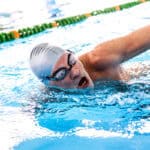
The sweet spot? Crown of your head breaking the surface, water line hitting near your hairline, eyes focused downward. This neutral position keeps your shoulders relaxed and rotation smooth, preventing that nagging swimmer’s shoulder that plagues so many technique-challenged swimmers.
How buoyancy and gravity impact streamline
Water physics work against most swimmers, but understanding these forces lets you work with them instead. Your body experiences a constant tug-of-war between buoyancy (centered in your chest where your lungs create natural flotation) and gravity (pulling from your body’s center of mass lower down). This mismatch creates an underwater torque that wants to sink your legs.
Elite swimmers master this relationship by engaging their core to shift internal organs cranially, effectively bringing their center of gravity closer to their center of buoyancy. Meanwhile, your body’s shape changes—at the head, back, and buttocks—create pressure gradients that add drag. Swimmers with aligned head positions experience roughly 20% less drag at race pace .
Even your breathing style matters here. Chest breathing versus belly breathing shifts these balance points differently. Poor posture on deck translates directly to poor positioning in the pool, especially when fatigue sets in. That rounded-shoulder “swimmer’s posture” might look the part, but it limits spinal motion and increases resistance.
Drills to improve horizontal balance
Fixing body position takes deliberate practice with drills that teach your nervous system what proper alignment feels like:
Front Float Drill – Start simple in chest-deep water. Float face-down with arms at your sides and notice how your hips naturally sink below chest level. Now press your chest down while lifting your hips up until you achieve horizontal balance. This teaches the fundamental seesaw relationship between chest and hip positioning.
Banded Legs Drill – Advanced swimmers should try freestyle with legs bound together, no kicking, no pull buoy. Sinking legs? Your head’s too high. This drill gives brutal honesty about head position without the masking effect of your kick.
Chin Tuck Exercise – Originally designed for neck pain relief, this strengthens the deep neck flexors while stretching tight suboccipital muscles. Practice throughout your day to build muscle memory for proper head carriage.
Dead Man’s Float to Streamline – Begin floating with full lungs, observing how your head, arms, and legs naturally sink while your chest stays up. Gradually extend into streamline, hold for several seconds, then ease into kicking before adding strokes. This progression reveals exactly how your body wants to position itself in water.
Perfect body position means your head stays neutral—gaze directed about 3 feet ahead during freestyle. When breathing, keep one goggle in the water to avoid head lifting. Many coaches teach “swimming downhill” visualization to naturally encourage proper head position and higher body alignment.
Elite swimmers prove that body alignment isn’t just technique—it’s applied physics. Head, hips, and heels in a horizontal line create that perfect streamline that minimizes resistance. Small head adjustments yield massive efficiency gains: properly aligned head position reduces drag by 10.4-10.9% with arms extended overhead.
Mastering body alignment means understanding both the physics and developing the kinesthetic awareness to feel proper position. With focused practice, you’ll transform from swimming uphill against resistance to gliding downhill with the water working for you instead of against you.
Swimmers rotate inefficiently during strokes
Proper body rotation separates the smooth swimmers from the strugglers, yet it’s one of the most misunderstood elements of stroke technique. The sweet spot sits between 35-45 degrees per side—any more or less, and you’re sabotaging your speed and efficiency. What’s fascinating is how many swimmers think they’re rotating properly when they’re actually creating unnecessary drag with every stroke.
How over-rotation or under-rotation creates drag
Get your rotation wrong, and your entire stroke falls apart. Swimmers who crank past that 50-60 degree mark lose their balance completely, turning their beautiful freestyle into a side-to-side wrestling match with the water. Here’s what happens when you over-rotate:
- Your streamline gets trashed as your body profile balloons in the water
- That flutter kick timing gets completely out of sync, creating a “hiccup” effect
- You’re stuck waiting to rotate back, which delays your next stroke and kills your rhythm
- Your shoulder joints take unnecessary punishment during the catch
But under-rotation isn’t any better. Your shoulder joint simply wasn’t built to handle freestyle with a flat body position. Without proper rotation, forget about getting your arms over the water cleanly or setting up that powerful pull phase.
The timing aspect reveals the real problem. Freestyle swimmers who over-rotate get stuck on their side too long, forcing their catch wide and outside their body line. Backstrokers face the same issue—over-rotate and your hand enters behind your head instead of directly above your shoulder. Both scenarios kill your propulsion.
Correcting cross-body arm and leg movement
Crossover might be the most common rotation mistake we see on pool decks. About half the swimmers at technique clinics are guilty of this stroke-killer. Your hands should enter in line with your shoulders, not across your body’s centerline. When you cross over, you’re setting up a cascade of problems:
- Hands entering in front of your head or past your body’s midpoint
- That thumb-first entry that flattens your position
- Recovery arm momentum carrying your hand across the centerline
Here’s what one experienced coach told us: “If you are crossing over the center it impacts what is happening under the body with the catch and the pull. It can then impact the legs causing them to come outside of the body line when kicking”. Plus, crossover creates that dreaded “wiggle-butt” or “snaking” pattern—you’re wasting energy moving sideways instead of forward.
The fix? Think “train tracks.” Picture two parallel lines running alongside your shoulders and ears—that’s where your hands should enter . Most swimmers need to exaggerate the correction initially, entering much wider than feels natural. As one technique specialist puts it: “Anyone who is crossing over a lot 9 times out of 10 they need to make it feel extremely wide”.
Want an immediate improvement? Try entering pinkie-first instead of thumb-first for freestyle. This small adjustment naturally guides your arm into a straighter entry path without crossing the centerline.
Using core engagement to stabilize rotation
Core stability makes the difference between controlled rotation and wobbling through the water like a broken compass. Your torso should move as one unit, not twist between hips and shoulders. When your core is weak or disengaged, maintaining a straight stroke path becomes impossible.
Smart swimmers use these core engagement strategies:
- Pull that belly button toward your spine throughout each rotation
- Use the “bracing method”—tense your core like you’re about to take a light punch
- Picture squeezing into tight jeans—that’s the level of abdominal engagement you need
- Connect your hips directly to your pulling motion through active core work
With proper core engagement, you create a “wave of motion” that starts at your hips and flows smoothly to your shoulders. Swimmers who just “throw” their shoulders over without core connection often end up with shoulder pain because they’re isolating that joint instead of using their whole body.
The sequence matters: hip initiates the downward roll as your arm recovers, core transfers that power through your torso, shoulder follows naturally into position, all while your head stays rock steady. This coordination keeps your rotation angles and stroke mechanics perfectly aligned.
Drills to synchronize hips and shoulders
Want to nail the hip-shoulder connection? These targeted drills isolate the rotation components before you put it all together:
- Hip-Driven Rotation Progression This four-part sequence builds serious hip-driven rotation power:
- 12-kick switch: Rotate side to side every 12 kicks, arms at your sides
- 6-kick switch: Same drill, half the kicks per side
- 3-12-3: Three perfect strokes, then 12 kicks on your side with lead arm extended
- 3-6-3: Same pattern with only 6 kicks between transitions
- Shoulder Tap Drill – Perfect for reducing over-rotation while improving hand placement. That physical shoulder tap reinforces proper arm positioning without any centerline crossing.
- Entry Alignment Drill – Zero in on correct hand entry position. This drill cranks up your stroke awareness, especially for shoulder and hand alignment during entry.
- Freestyle with Snorkel – Remove breathing from the equation entirely so you can focus purely on rotation mechanics. The snorkel “keeps swimmers honest” by forcing rotation from hips and core rather than using breath timing to drive uneven rotation.
- Wide Recovery Drill – Exaggerated width helps you break those ingrained crossover habits by emphasizing wider arm recovery paths.
Backstrokers benefit from practicing with arms extended overhead, holding for 6 kicks to get immediate feedback about arm positioning. Both freestyle and backstroke swimmers should try the OK sign drill (index finger and thumb forming a circle)—it naturally prevents crossover.
The payoff for fixing your rotation is immediate: enhanced propulsion with reduced drag. Focus on developing rotation angle awareness, maintaining core engagement throughout your stroke cycle, and nailing that hip-shoulder timing. Get these elements working together, and you’ll feel the difference in your very next lap.
Swimmers breathe incorrectly and disrupt rhythm
Breathing might seem like the most natural thing in the world, but put a swimmer in the water and suddenly it becomes their biggest nemesis. Here’s a startling fact: 8 out of 10 endurance swimmers see immediate pace improvements just by fixing their breathing technique. Yet most swimmers keep making the same breathing blunders that kill their rhythm and sap their energy.
Swimming demands something no other sport requires—you’ve got to consciously choreograph every single breath with your stroke mechanics. Miss that timing, and your beautiful freestyle turns into a thrashing mess.
Common breathing errors: lifting head, late inhale
The biggest breathing blunder? Lifting your head like you’re trying to peek over a fence. This tiny mistake becomes a massive problem. As one seasoned coach puts it perfectly: “If you pick your head and look forward to breathe, or rotate too much (aka sky breathing), your head is no longer aligned with your spine and core, which affects the entire stroke, including your kick”.
Then there’s breath stacking—that sneaky habit where you don’t fully exhale before grabbing your next breath. Picture trying to fill a half-full glass with more water. That stale air sits in your lungs, blocking fresh oxygen from reaching your muscles where it’s needed most. Swimmers who hold their breath underwater face the same oxygen starvation, turning what should be smooth, rhythmic swimming into a battle for air.
Timing becomes another killer. Rush your breath because you waited too long, and suddenly your entire stroke cycle falls apart. Many swimmers think they’re rotating from their shoulders when breathing, but they’re really just cranking their neck sideways —a recipe for both inefficiency and injury.
How poor breathing affects stroke timing
Bad breathing doesn’t just mess with your air supply—it demolishes everything else you’re trying to do right. Lift that head too high, and watch your hips drop like a rock, creating drag that slows you down instantly. Your beautiful body position vanishes in seconds.
Beginners especially fall into the trap of over-rotating to breathe, turning their heads so far they might as well be looking backward. This throws off their balance, forcing them into awkward scissor kicks just to stay afloat. When you’re breath stacking, your respiratory system goes into overdrive, creating stress that robs your muscles of precious oxygen.
Poor breathing creates a domino effect—disrupted body position leads to compromised stroke mechanics, which forces more frequent breathing, which further messes up your rhythm. Some swimmers even start crossing their arms over their centerline to compensate for inadequate rotation during breathing, adding even more drag and inefficiency.
Tips for bilateral breathing and exhalation control
Bilateral breathing—switching sides with each breath—offers a game-changing advantage for stroke balance and injury prevention. Smart swimmers know how to master this skill:
- Start small: Work bilateral breathing into your warm-ups and cool-downs before tackling main sets
- Try the 2-2 pattern: Alternate breathing sides every 2 strokes to maintain oxygen while building balance
- Keep one goggle wet: Always maintain one goggle in the water while breathing to prevent head lifting
- Empty those lungs: Complete exhalation underwater prevents that dangerous breath stacking
- Use the “bubble, bubble, breathe” rhythm: This simple cue keeps your underwater exhalation consistent
Master the art of trickle breathing—controlled nose exhalation while your face stays underwater. This technique ensures you’re completely emptying your lungs before each fresh breath. The bonus? Controlled exhalation actually helps you relax and reduces the time needed for inhalation, keeping that perfect head and hip position intact.
Drills to fix breathing technique
Transform your breathing with these targeted drills that build the right habits:
Bubble-Blowing Drill: Swim with steady underwater exhalation through nose and mouth. This foundation drill builds breath control and consistent exhalation patterns.
Kickboard Breathing Drill: Hold a kickboard while practicing side breathing with steady kicking. This isolates breathing mechanics without arm stroke interference, letting you focus purely on head position and rotation.
Bilateral Breathing Progression: Start alternating every three strokes, then gradually extend to five or seven strokes. This systematic approach develops balanced breathing while expanding lung capacity.
Hypoxic Training: Progressively increase strokes between breaths—start at every two strokes, then build to three, four, and beyond. Your lung capacity and breath control will thank you.
Split Vision Breath Drill: Practice with one goggle in water, one out, using steady kicking with one arm extended forward. Breathe with minimal rotation and return your face immediately to water.
Here’s something that’ll blow your mind: normal breathing only uses about 75% of your lung capacity, leaving a quarter filled with stale air. Proper breathing exercises tap into that unused capacity, improving oxygen delivery and delaying the buildup of lactic acid that makes your muscles scream.
Swimming stands alone as a sport demanding complete conscious control over breathing mechanics. Master these drills and breathing principles, and you’ll turn what used to be your biggest struggle into your secret weapon for better proper breathing technique.
Swimmers pull water with poor hand mechanics
Here’s where the magic happens—or where it all falls apart. The pulling phase separates swimmers who glide through the water from those who struggle for every meter. Watch an elite swimmer’s underwater stroke and you’ll see a masterclass in hand mechanics. Then watch most recreational swimmers, and you’ll witness technique that’s working directly against them.
Even competitive swimmers mess this up more than they’d like to admit. Those precise hand positions that create real propulsion? They’re getting sabotaged by subtle mistakes that drain power and add drag with every stroke.
Why elbow drop reduces propulsion
Drop your elbow during the pull, and you might as well be trying to paddle with a wet noodle. When swimmers let their elbows sink below their hands, they’re throwing away the entire paddle surface created by their forearm and hand. The result? You’re pulling ZERO water and generating virtually no forward momentum.
This isn’t just inefficient—it’s backwards. Instead of creating that large surface area to push water behind you (which rockets you forward), a dropped elbow sends water straight down. You’re not moving forward; you’re just churning water while working twice as hard.
The muscle recruitment tells the whole story. High elbows engage your powerful lats—those broad back muscles built for generating serious force . Drop those elbows, and you’re stuck using your smaller shoulder muscles, which tire quickly and can’t generate the same power. Plus, you’re setting yourself up for shoulder problems down the road.
Correcting hand entry and catch phase
Perfect pulling starts before you even begin the pull—it starts with where and how your hand enters the water. Picture a clock face above you: your hands should slice in at 11 and 1 o’clock, creating those railroad track pathways that keep everything aligned.
The thumb-first entry that many swimmers default to? It’s setting you up for failure by forcing internal shoulder rotation. Lead with your middle finger instead—cleaner entry, less splash, better positioning for everything that follows.
Once you’re in the water, here’s your checklist:
- Enter with authority—no tentative hand placement
- Full arm extension before you start the catch
- Fingertips angle down toward the pool bottom while that elbow stays high
- Fingers together on entry, then let them separate slightly during the pull
Want a performance hack? Try rotating your pinkie downward after entry. This small adjustment can slash frontal drag by 9.5% at race speeds —especially effective for distance swimmers using hip-driven technique.
How to maintain high elbow during pull
Elite distance swimmers have figured out the secret: keep that elbow near the surface throughout the entire pull, with your hand driving backward underneath. They’re trading some raw power for dramatically reduced drag—a smart trade for anything longer than a sprint.
The technique builds from proper setup. After full extension, your hand and forearm tip downward while your elbow holds high. Coaches call this “early vertical forearm” or EVF —and it transforms your arm into a massive paddle for grabbing and pulling water .
The mechanics are specific:
- Elbow rides about an inch below the surface during the pull
- Hand stays directly below your elbow—never outside that line
- Fingertips point down to the pool bottom throughout
- Maintain that shoulder-to-hand straight line
Yes, it feels weird at first. But this technique keeps your upper arm aligned with your body movement during the critical early pull phase—exactly when reducing drag matters most.
Drills to build muscle memory for proper pull
Building proper pull mechanics takes targeted practice. These drills isolate the movement patterns until they become automatic:
One-arm drill: Swim with one arm while the other stays extended or at your side. This laser focus on each pull phase reveals exactly what your arm is doing without the distraction of bilateral movement. Switch arms every few lengths.
Sculling exercise: Head down, arms forward, drop your forearms to 45 degrees with elbows pointed ahead. Scull your hands in and out with rigid wrists—this engages the exact scapular muscles you need for high-elbow pulling.
Fist drill: Close your hands and swim freestyle. Without your palms to rely on, your body automatically optimizes forearm position to maintain speed . It’s like forced feedback for proper technique.
Deck-ups: At the pool edge, place your hands on deck and pull yourself up while maintaining high elbows. Immediate feedback plus strength building for the exact muscles you need.
String these drills together consistently, and you’ll develop the proprioception and muscle memory that makes efficient pulling feel natural. Your arms will know exactly where to be throughout the entire stroke cycle.
Swimmers kick inefficiently and waste energy
Here’s the thing about kicking that drives coaches crazy: swimmers put tremendous effort into their legs, yet most of that energy goes nowhere. Watch a typical workout, and you’ll see swimmers churning up white water with oversized kicks while barely moving forward. Meanwhile, the smooth swimmers next to them maintain compact, purposeful kicks that actually contribute to their speed.
How deep or wide kicks slow you down
Picture this scenario—you’re swimming through an invisible tube. Efficient swimmers stay within that narrow space, while strugglers kick themselves outside it constantly. Those oversized kicks aren’t just wasting energy; they’re actively working against you. Every time your kick goes too wide or deep, you’re essentially swimming through a truck tire instead of slicing through water.
The real problem? Most swimmers treat kicking like they’re riding an underwater bicycle. That knee-heavy “pedaling” motion pushes water straight down instead of back, creating zero forward thrust . Smart swimmers know the power comes from the hips and core, with knees bending just enough—about 120 degrees maximum. Your legs should move like a whip, not like you’re trying to pedal uphill.
When kicks get too big, everything falls apart. Body position collapses, streamlining disappears, and suddenly you’re working twice as hard to go half as fast. Keep those kicks tight and controlled within your body’s slipstream, and you’ll generate genuine propulsion while maintaining that crucial balanced position.
Importance of ankle flexibility and toe point
Want to know what separates natural kickers from the rest? Flexible ankles, hands down. Swimmers with superior plantar flexion—that’s pointing your toes like a ballet dancer—consistently post faster kick times than their stiff-ankled counterparts.
Think about where your propulsion actually comes from: the tops of your feet acting like little propeller blades pushing water backward. Rigid ankles turn your feet into drag-creating anchors instead of propulsion-generating fins. It’s the difference between swimming with built-in flippers versus trying to kick while wearing work boots.
Drills to develop a compact, fast kick
Getting your kick dialed in takes focused practice with specific drills that train both technique and muscle memory:
Mail Slot Kicking: Imagine swimming through a slot barely wider than your shoulders. Focus on rapid, compact kicks that keep your feet completely underwater. This drill forces proper body alignment while developing that narrow, efficient kick pattern.
Hip-Focused Kickboard Work: Grab a board and concentrate on high-tempo kicks that originate from your core, not your knees. Feel that wave motion starting from your hips and flowing down through your legs.
Wall Kick Practice: Hold the pool wall with your face down, maintaining perfect body position while experimenting with kick rhythm and depth. This gives you immediate feedback about what efficient kicking actually feels like.
Fin Training Sessions: Fins aren’t just for fun—they teach proper foot positioning and help develop ankle flexibility. The added propulsion also lets you feel what effective kicking contributes to your overall speed.
The secret to great kicking lives in that sweet spot between too much and too little—steady, narrow, and purposeful. Think Goldilocks: not too big, not too small, but just right. Master this balance, and your kick transforms from an energy drain into a genuine speed booster.
Conclusion
These five stroke mistakes might seem subtle, but they’re the difference between loving your time in the water and dreading every lap. You’ve now got the inside knowledge that separates frustrated swimmers from those who genuinely enjoy their training sessions.
Your head position sets the stage for everything else—keep it neutral and watch those hips rise to the surface where they belong. Master that sweet spot rotation of 35-45 degrees, and you’ll feel power flowing through your entire stroke cycle. Get your breathing rhythm dialed in with complete underwater exhalation, and suddenly those longer sets become achievable rather than intimidating.
The pull phase is where the magic happens. That high elbow position isn’t just about looking good—it’s about tapping into your strongest muscles and creating real forward momentum. Pair it with a compact, hip-driven kick, and you’ve built yourself a stroke that works with the water instead of against it.
Here’s the exciting part: every swimmer can master these fundamentals. The physics don’t change based on your current ability level or how long you’ve been swimming. Whether you’re just learning freestyle or you’ve been competing for years, these technical fixes work the same way for everyone.
Your next pool session is a chance to feel the difference immediately. Start with just one element—maybe focusing on that head position or working on your rotation timing. Build these improvements gradually, and you’ll discover what efficient swimming actually feels like. That effortless glide you see in other swimmers? It’s not a talent you’re born with—it’s technique you can learn.
The water becomes your ally when you understand how to work with it. These aren’t just technical corrections; they’re your pathway to swimming that feels smooth, powerful, and genuinely enjoyable every single time you dive in.
Key Takeaways
These five technical corrections can transform your swimming from an energy-draining struggle into efficient, powerful movement through the water.
- Keep your head down and eyes focused 3 feet ahead – Lifting your head causes hips to sink, increasing drag by up to 10.9% and forcing you to swim “uphill”
- Rotate 35-45 degrees from your core, not shoulders – Hip-driven rotation with engaged core muscles prevents crossover and creates powerful, balanced strokes
- Exhale completely underwater through your nose – Practice bilateral breathing with full exhalation to prevent breath stacking and maintain proper stroke rhythm
- Maintain high elbows during the pull phase – Keep elbows near surface while hands push backward underneath to engage powerful back muscles instead of weaker shoulders
- Kick narrow and fast from your hips – Small, compact kicks from the core with pointed toes create propulsion without disrupting streamline or wasting energy
The difference between struggling swimmers and efficient ones isn’t fitness—it’s technique. These corrections address the root causes of swimming inefficiency, allowing you to cover greater distances with less effort while reducing injury risk.
FAQs
Q1. What are the most common stroke mistakes swimmers make?
The five most common stroke mistakes are misaligning body position, rotating inefficiently, breathing incorrectly, pulling water with poor hand mechanics, and kicking inefficiently. These errors can significantly impact swimming performance and efficiency.
Q2. How can swimmers improve their body alignment in the water?
Swimmers can improve body alignment by maintaining a neutral head position with eyes looking slightly forward, pressing the chest downward while lifting the hips, and practicing drills like the Front Float Drill to develop awareness of proper horizontal balance.
Q3. Why is proper rotation important in swimming?
Proper rotation is crucial because it allows for more efficient arm positioning, better leverage during the pull phase, and easier breathing. Ideal rotation for most strokes ranges between 35-45 degrees per side, driven from the hips rather than just the shoulders.
Q4. What are some tips for improving breathing technique while swimming?
To improve breathing, focus on exhaling completely underwater, turning your head to breathe without lifting it, and practicing bilateral breathing. Drills like the “bubble, bubble, breathe” exercise can help establish a consistent breathing rhythm.
Q5. How can swimmers develop a more efficient kick?
To develop an efficient kick, swimmers should focus on kicking from the hips rather than the knees, keeping legs long and in line with the body. Practice kicking drills in streamline position and work on ankle flexibility to improve propulsion while minimizing drag.